Every colour has 3 unique properties. When you are finding colours that suit you, you are looking for those colours that replicate your natural colour properties.
Value
The lightness to darkness of the colour. You can change a colour from it’s natural pure (rainbow) hue by:’
- Tint – adding white
- Shade – adding black
Some colours are natuarlly light in value – yellow is always light. Some are deep in value – indigo is always deep.
You can change a colour by adding white or black to make it lighter or darker.
Undertone and Overtone
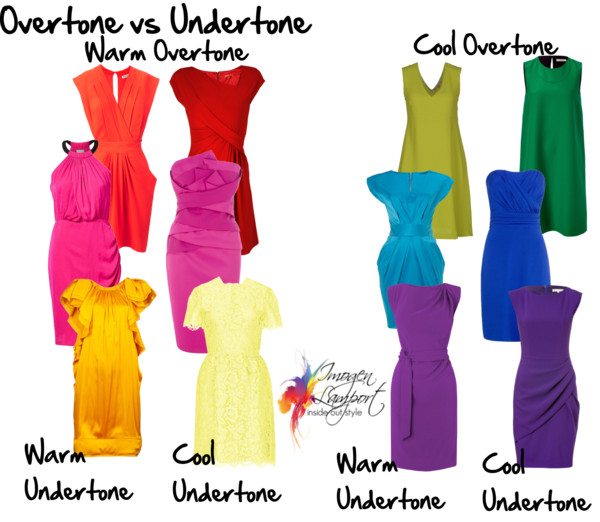
How warm or cool the undertone of the colour appears. Colours have both overtones and undertones.
Overtone – how we describe the colour psychologically – we describe yellow, orange and red as warm (overtone) because they relate to things that make us feel hot – the sun and fire. We describe blue and green as cool (overtone) as they relate to things that make us feel cool – water, cool lush foliage that shades us from the sun.
The Undertone of the colour is how the colour is created – when mixing colours to create that unique hue. Every colour (except orange) can have a warm or cool undertone by adding yellow or blue (or sometimes white or black will cool down a colour, and sometimes red will warm a colour up)
Warmth (yellow base) or coolness (blue base)
Intensity
The intensity of a colour is all about its saturation and brightness of it. It may be pure and bright, with little or no grey added or a tone – adding grey in higher amounts.
The brighter the colour, the more advancing it appears. The more muted/greyed down/toned the colour, the softer and smokier and more receding it appears.
When you’re selecting colours to wear, if you discover your own colour properties and work with them, you’ll find that the colours harmonise with you and create a face focus.
For instance, my colouring is cool, deep and fairly bright – so the colours I wear have these colour properties. It’s not that I can’t wear light colours, but I need to wear something darker with my lighter colours.
Colour Terminology Basics
The value of a colour just means how light or dark it is. Think about it being like this on a continuum from light to dark:
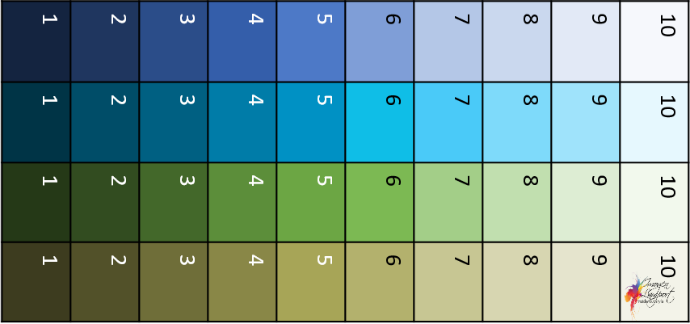
Really dark medium-dark medium medium-light light really light
Tints are lighter colours that have white added. The more white added the more milky and soft it becomes, as well as getting lighter and lighter.
Tones can be light, medium or deep in value, they are a colour that has been changed by adding grey. You can soften a colour down by adding a little grey, it won’t look grey, but just not as bright. You can add more and more grey to a colour to it becomes smoky and dull, and eventually, you will identify the colour as grey first, then with a hint of the original colour such as a bluey-grey or green-grey etc.
Shades are deep or dark colours. If they are medium deep they will retain brightness, in the way that colours that are tinted a bit, but not too much also can appear quite bright.
Pure colours are bright, crisp and clear. They have not been changed from their original form. Colour instensity – pure or soft, more on choosing colours.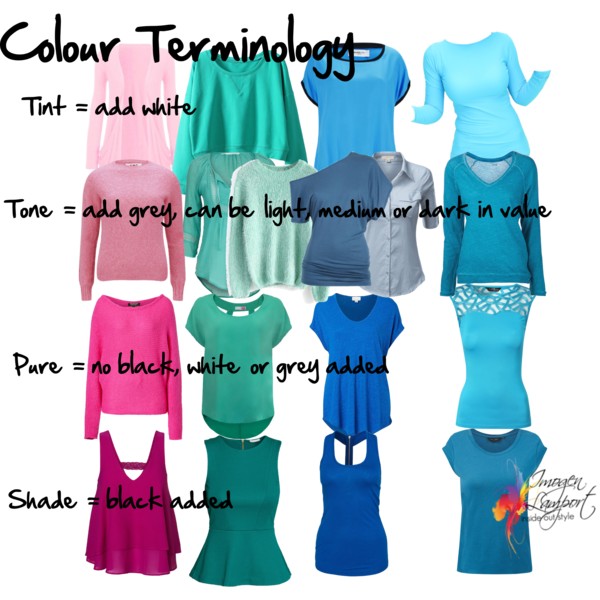
Start Your Training and Follow Your Passion
Get your first two lessons free – click here! Choose your own learning style as we offer personal stylist and personal colour anlaysis courses both in the classroom or online training. All image consultant training courses also include a 12 month mentoring program once your training has finished so that you succeed in setting up your own image business. We also offer ongoing educational webinars for all personal stylists on image and marketing related topics which you can access at any time from the comfort of your own computer.
Want more information about course content and pricing? Download our AoPI Course Outline Now!
Please do let me know if you have questions about the training. I’m excited about this rare opportunity and I don’t want you to miss out!